9 ways to learn Spanish faster
1 Find an Online Tutor to Speak With Each Week If you are just to do one thing in your quest to Spanish fluency, my recommendation would...

https://spanishtipsaz.blogspot.com/2019/01/9-ways-to-learn-spanish-faster.html
1 Find an Online Tutor to Speak With Each Week
If you are just to do one thing in your quest to Spanish fluency, my recommendation would be to focus on this method. Fact of the matter is, having an online tutor will quadruple your results compared to time spent in an actual classroom.
Why, you might ask? A classroom environment is focused on teaching several students (all learning at different paces) all at once.

At most, you might have a couple speaking interactions in one class sitting.
However, an online tutoring session is 100% focused on you the student. You are the reason for the class and since you are the focus you will do the speaking and hearing.
Having a good Spanish tutor is without a doubt the main reason I was able to get to Spanish fluency in less than a years’ time.
Where can you find an online Spanish tutor?
Go to Italki.com and filter for a Spanish teacher from the country that you are targeting or want to learn from. New students get $10 free after spending $10 with this special italki.com affiliate link.

If you want to learn Spanish from Spain then pick a teacher that is from Spain. If you are looking for a Latin American teacher, I have found Bolivia, Colombia, and Mexico to have a clear South American dialect (normally).
Amazingly, you can find an excellent teacher for $10 or less per hour. Through the power of the internet you can speak with someone thousands and thousands of miles away and get excellent targeted tutoring focused on you!
I always make sure to find a teacher that speaks Spanish with me (not English) and corrects my mistakes as I go. Italki has some excellent trial lessons to get you started for a very low price ($5 or less) so you can figure out who you enjoy most as a tutor.
You have nothing to lose.
Pro Tip: Schedule lessons at the beginning of the week so that you have them on your calendar before your week gets jam packed with activities and events.
2. Lean from online course
3. Lean from Quora
There are many userful topics on Quora.
Visit Quora and search: how to learn spanish
4. Study your grammar: Learn the important tenses and how to conjugate verbs

Now, this is a surprisingly controversial topic.
The classic wisdom of language learning was that grammar was of super importance. Many of you may remember, as I do, sitting in school learning in-depth analyses of the grammar of French and German even though we had no idea how our own worked.
Modern teaching tends not to be too obsessed with grammar - thank God!
But some go even further.
Spanish to Move make a very good case for the idea that grammar study isn’t even needed at all.
“Grammar should be learned the way a native speaker of any language learns it; that is, by listening again and again and copying the words that he or she hears, just as babies do. Thus, when a child is five or six years old, he or she can already use the grammatical structures correctly, even without being able to read.”
This kind of thinking runs counter to what we expect, but it makes sense that intuitive learning would be effective for something so… well… intuitive.
But it’s not just a few claims about the way children learn which informs this position. Research from the Centre for Languages, Linguistics, and Area Studies (LLAS) suggests that listening alone, when provided with context, can lead to high levels of comprehension with or without high-level grammatical understanding.
Nonetheless, I’m not fully sold on the idea of abandoning grammar learning altogether.
Learning how regular verbs conjugate in Spanish and knowing that immediately off the top of your head is the most satisfying moment of progress you’ll have after learning to properly roll your Rs.
You suddenly live in a world where you have command of verbs. You can construct and manipulate sentences like some kind of language God. You can be understood.
It’s a magical feeling.
For Spanish, learning the conjugations and learning why we say me gusta instead of yo gusto is basically the level of grammar I’m claiming is important to have at this point.
If you want to write essays in Spanish and construct complex sentences then, by all means, commit yourself to the world of subjunctives.
I’m just saying you don’t need to take that burden upon yourself at this point. Learn what you need to enjoy the language.
5. Use Language Exchanges with Native Speakers
Language exchanges are yet another excellent and free way to learn Spanish.
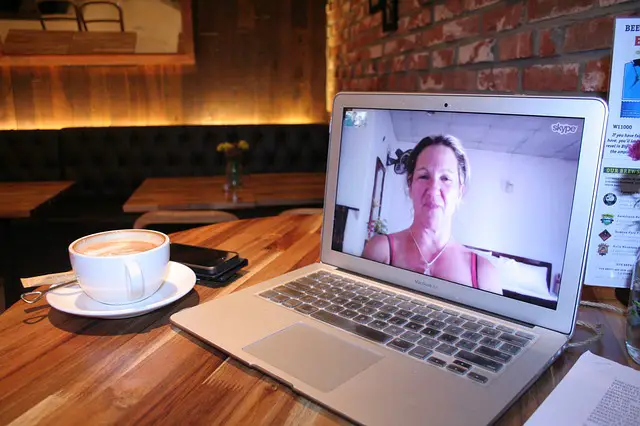
Unlike anytime in history, you can speak with someone from Spain from anywhere in the world as long as you have an internet connection.
I have met some amazing friends from all over the world.
All you need to do is ask a native Spanish speaker, “let’s spend the first 30 minutes speaking in English and the next 30 minutes speaking in Spanish.”
The amount of time can vary, but the important part is you are meeting some new friends.
I also found that a lot of my Latin friends were content just speaking Spanish the whole time and only wanted a friend to converse with. So basically, I had an informal Spanish lesson with a native speaker without spending a dime.
Where can you find these Spanish language partners?
Italki allows you to search for a plethora of native Spanish speakers eager to strike up a conversation. You can quickly exchange Skype information and then schedule a language exchange.
Another site that is focused strictly on language exchanges is Conversation Exchange.
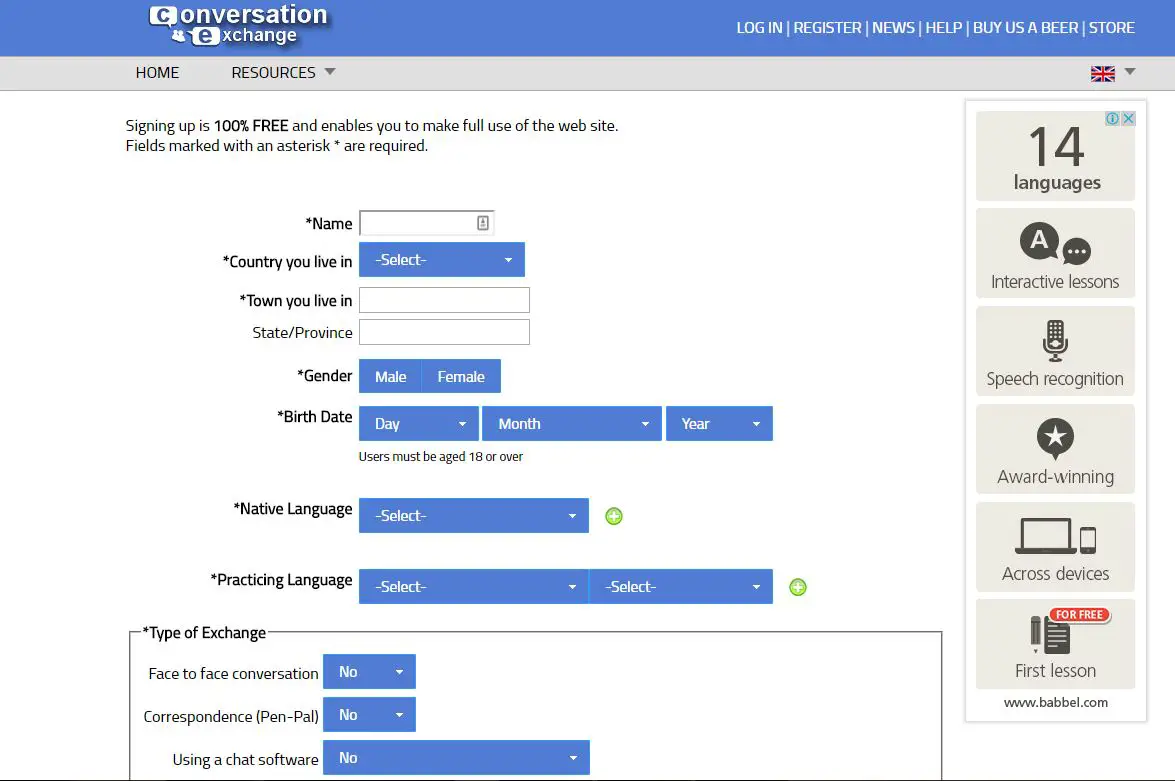
This site is great as it allows you to meet other language partners in your area. A lot of times you can find a language partner that lives in your own city with the simple search tool on the site.
I actually met a good friend from Spain who lived about an hour away from me.

Beyond that it has an option to meet faraway internet friends just like on Italki.
When I was using the site, it actually issued the following warning:
“Important: A profile may be rejected if the primary reason for subscribing is not language exchange. You may not enter any personal or sensitive personal information.”
I can honestly say my primary reason to use this site was to meet people for a language exchange.
I never would have thought that I would have met my wife, Andrea, on it!
It’s amazing to think that if we had grown up 10 years earlier we probably never would have met.
Pro Tip: Filter by the dialect of the speaker that you are looking to learn from. If you are learning the Spain dialect then make sure to filter by people from Spain.
6. Use a Flashcard App with Spaced Repetition Technology

Flashcards are the perfect way to learn vocabulary. There are several very good flashcard apps that you can use right from your cell phone.
It’s crucial that you don’t just study with any old flashcards. You should make sure to use a flashcard app that incorporates space repetition software.
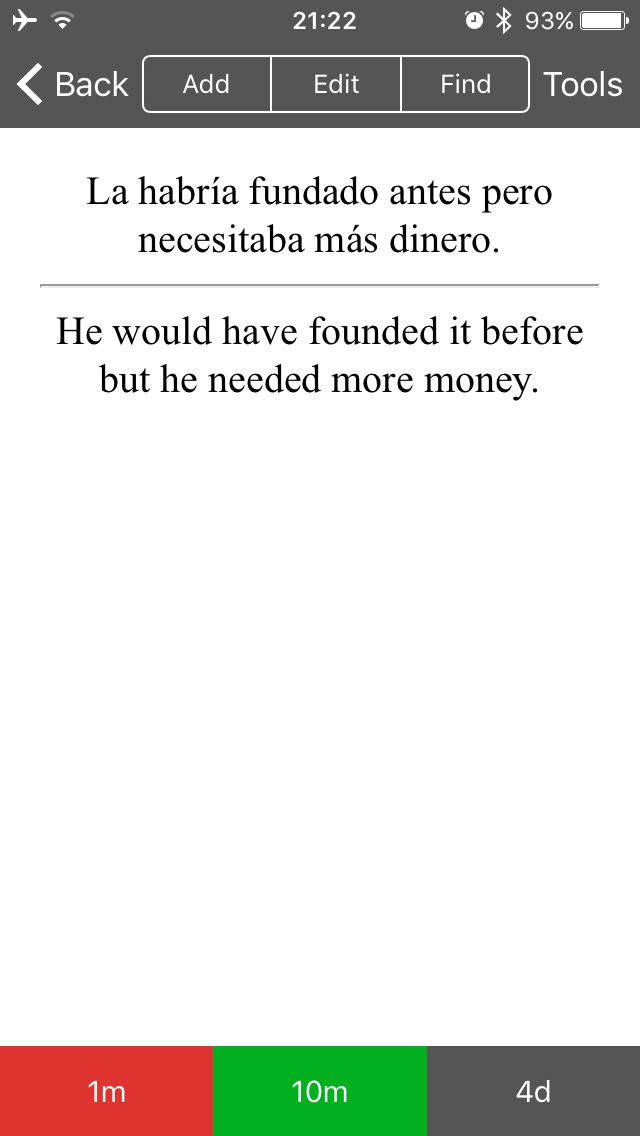
Notice how you can select if you want to see the card in 4 days.
I use the Anki app on my phone and absolutely love it. Anki is great as they allow you to choose the flashcards you do and don't understand.
For the words that you do have a good handle on, the app stores the flashcard away for a month or two later.
Basically, you select the words that you have a grasp for and the app presents them to you less frequently.
Then, just in the nick of time, it shows back up as a flashcard to make sure you don’t forget it.
The best part is Anki has public flashcards that you can download direct to your phone and start using right away.
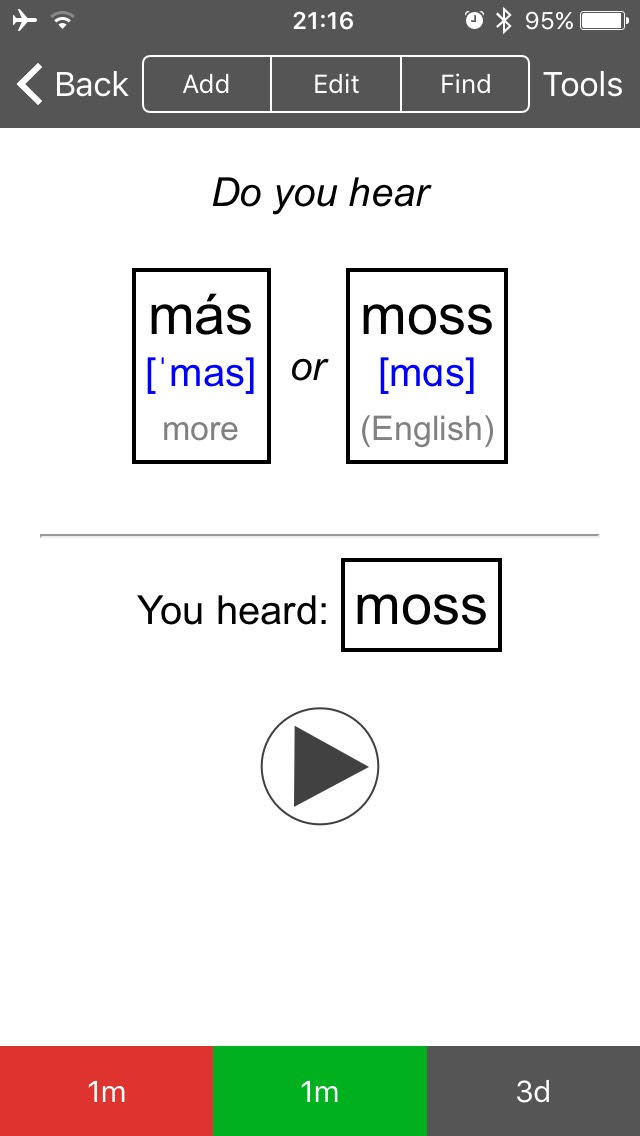
If you are lazy like me and don’t want to create all the flashcards, just download a highly rated public one and start using it.
It is important to pick flash cards that integrate sentences, audio, or pictures into the flashcards. Our brains tend to remember stories and imagery a lot better than just individual words.
This is probably one reason why you couldn’t remember anything from your high school biology class.
Here’s another quick recommendation.
If you are first starting out, get started learning only the most common words. No point learning obscure Spanish words that you will rarely use. Just get started with the ones that are used 80-85% of the time in regular conversation.
Pro Tip: Delete 1 Social media app from the front screen of your phone and place your flashcard app front and center. Whenever you are bored, open up the flashcard app (instead of the social media app) and use it for 5-10 minutes.
7. Listen to Spanish Podcasts
Podcasts are great because you can listen to them whenever you are doing unengaging activities like walking the dog or folding the laundry.

Basically, anything that doesn’t require your brains attention makes for the perfect time to listen to a Podcast episode.
You can easily download or stream free episodes from the Podcast app on iOS or the Stitcher app for Android.
There are some great Podcasts out there for those that like hearing the Spanish language in spoken format.
Below are my three favorites.
Coffee Break Spanish - (For Beginners and Intermediates)
Far and away the best Spanish Podcast out there (IMO). I used this Podcast early on and loved it.
They have fun and engaging episodes that teach you the essentials of the language.
They even created an interesting storyline in which they break down the intricacies of the language through the story.
Notes in Spanish - (For Intermediates and Advanced)

Ben and Marina do an excellent job hosting this conversational Podcast.
The Podcast features short 15-30 minute conversations between the two. They have about 100 episodes to get you going.
They speak with a dialect from Spain so it is especially good for those learning Spanish from Spain.
Españolistos - (For Intermediates and Advanced)
Naturally, I couldn’t recommend a Spanish Podcast without recommending our own, could I?

My wife, Andrea, and I (gringo) made this Podcast for Latin American Spanish Learners who wanted to hear conversations on various topics.
Like Notes in Spanish, we speak on many different things from politics to music to American history. We don’t shy away from controversial topics as we feel that diving deep into vocabulary will only increase your comprehension.
We communicate in Spanish 99% of the time as the Podcast is focused on High intermediates and Advanced Spanish learners.
Pro Tip: When listening to a Spanish Podcast, follow along with the transcript so that you can be reading and hearing at the same time!
8. Read Books in Spanish
This one can be a difficult. It was so difficult that I often neglected it early on in my studying.

If you like reading, why not trying reading a book in Spanish?
I did this with the Narnia series and although I didn’t understand every word, I understood most of it and still found it just about as enjoyable as I would have in English.
Rather than review every single word I didn’t understand, (that would take forever), I looked up the common words that kept coming up. Who would have thought that “enano” meant dwarf in Spanish?
If you are finding this method to be too intimidating, just pick out your favorite book in the Spanish translation. Just about every popular book these days is translated into Spanish.
I picked out one of my favorite books in the Spanish translation. Since I had already read this book a couple times in English I already knew the storyline and what was going on in each chapter.

This allowed me to understand the words as I had an idea of the plotline. I experienced the book in a whole new way.
I think this is the perfect way to get started with a Spanish book.
In case this still frightens you, I would say you should attack it like the 20-mile march mentioned above.
Spend 5-10 minutes each morning reading a few small passages. It’s ok if you read slower. The important part is you are making progress through reading.
Pro Tip: If you read on a Kindle device, you can highlight the words in Spanish and get the definition for the words that you don’t understand. Granted, the definition is in Spanish so hopefully you will be able to understand the definition.
9. Begin Writing in Spanish
If you haven’t noticed by now, our Spanishland School motto is, “Piensa como nativo.”

We truly believe that in order to achieve Spanish fluency you need to start thinking and acting like a native speaker.
How can you do that?
By immersing yourself in the language, you will slowly start to think like a native. One way to start thinking in Spanish is to start writing in the language.
Do you do a daily journal?
If you already do, why not try to write at least half of it in Spanish. This is a great way to stretch your mind and push yourself to use and think up new words.

Early on, I set a goal to scribble down half a page of my thoughts each morning in Spanish. I did this at the same hour every day during my regular study time.
I forced myself to use new words that I had learned in my flashcard app.
Then, after writing them down, I made sure to use them in my conversations with my Spanish tutor later on in the day.


